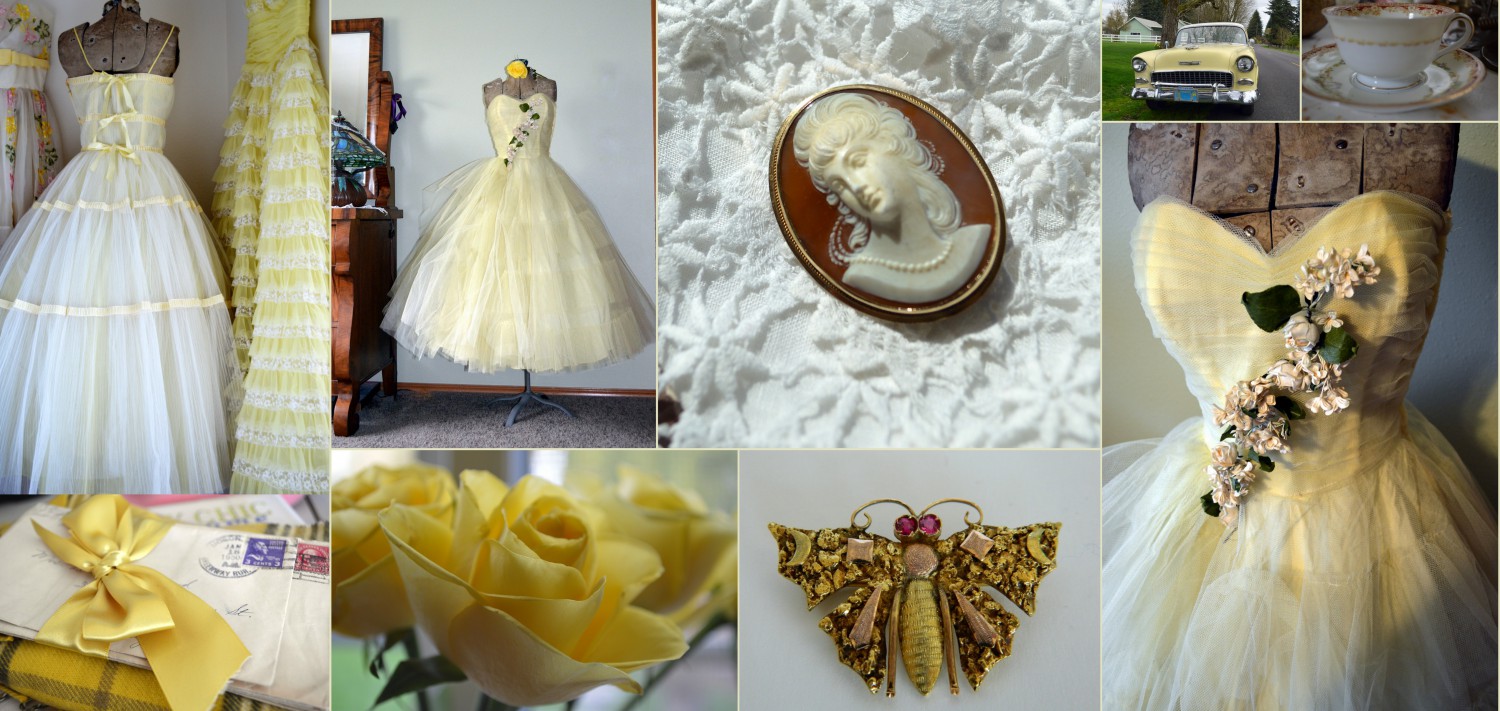
 “Vintage is about looking forward through the window of the past,” says Charles March.
Hope you are having a good day! My newest postcard. & I Love this quote!
“Vintage is about looking forward through the window of the past,” says Charles March.
Hope you are having a good day! My newest postcard. & I Love this quote!
Gerontologists say that reviewing your life is a normal developmental step of middle adulthood. Joyce describes it as when you “make the transition from the younger person you used to be to the older person you’re becoming. When you become the storyteller, the keeper of the wisdom, of the family memories.”

“She is telling her mom’s story but she is also telling her story,” Sasser says. “Creativity helps us cope and understand the world.”
http://www.oregonlive.com/living/index.ssf/2011/01/the_process_of_caring_for_a_mo.html
Click on this link above and read this article watch the video! This quote gave me some great ideas, I love this it is so inspiring and creative! What a brilliant idea documenting the surroundings of loved ones in a difficult time, preserved on film to remember at a later date when things have calmed down and one has opportunity to reflect and treasure the scene.

If I post an entry every Monday to Friday, I’ve got to come up with over 250 posts per year, so I need ideas. Please suggest some to me. This one comes from my daughter, Nicole. She asked me to answer questions that are commonly asked of me at shows. I was asked this question on Sunday at the Redondo Beach Antiques Fair. “How can you tell an etching is authentic?”

Louis Icart pulling a proof of Joy of Life from the etching press
First you have to understand the process of producing an etching. The artist does his work on a copper plate, so the “original” is a copper plate and that’s rarely ever for sale. To produce the image, first the plate is hand-inked. Then the paper is laid down on top and the two pass together through the etching press, under tremendous pressure. The pressure transfers the image to the paper. Since the copper plate has thickness, it “dents” the paper around the edge of the image. This “dent” is called a plate impression. You can see it and feel it around the edge of the plate. So #1. A real etching has a plate impression.
Since the process is not photographic and there is no printing press, there are no dots in the image. If you use a magnifying glass to look at a photograph in a newspaper, you can see the entire image is made up of dots. Use a magnifying glass with an original etching and there are no dots. So #2. An authentic etching does not have any dots in the image.
After the edition is printed by the master printer, it is given back to the artist to hand-sign each one. Prints or other fakes have copies of the signature. So #3. Authentic etchings are hand-signed by the artist, usually in pencil.
In the case of Louis Icart, a raised seal called a blindstamp, was created in mid-1926, and is usually found in the lower left corner, just below the image. Most Icart images produced after this time have the blindstamp, but don’t use this information as a crutch. There are some fake etchings that have fake blindstamps. And conversely, there are many authentic Icart etchings that do not have a blindstamp. Supposedly the etchings without blindstamps were not for export from France, but personally I’ve found too many instances where this rule doesn’t seem to follow.
If you like my blog, please recommend it to others. Email me with your comments and suggestions. philchasen@gmail.com
Thank you Mr. Chasen! I am photographing this Icart to sell and your blog was so helpful to me so I wanted to share! 🙂
BEWARE of phony poster prints on ebay from Boca Raton. The are selling in the $350 range to unsuspecting buyers. They have forged signatures, phony seals and made-up edition numbers
Below: One of the many mmodern FAKE seals as seen on ebay and other places.
http://www.hollandarts.com/ICARTETCHINGS.HTM

I couldn’t help but wonder what these tongs were originally made for? I certainly am not an expert on research but this I am thinking, they were for asparagus. Note my research below……..
‘Asparg’, meaning ‘sprout’ in Persian becomes ‘asparagos’, ‘shoot’ in Greek. It is a member of the lily family, a relative of onions, garlic and that food of the Gods and Welshmen, the leek. The Romans, like the modern Italians, were wild for asparagus. In Rome itself it was eaten with olive oil until Julius Caesar was offered a dish in Mediolanum, now Milan, served with butter.
Plutarch records that Caesar liked it very much, relishing both its taste and its speed of preparation, perfect for a busy man with a continent to run. “In the time it takes to cook asparagus” became the Roman equivalent of a New York Minute – not much time at all. source http://www.telegraph.co.uk/foodanddrink/7724041/There-is-so-much-to-love-about-asparagus.html
Tongs formed from a single piece of silver can be dated to the late 1700s. These were often engraved, and many had a noticeable concave running on the inside of the tongs, from tip to tip. Sometimes the arms ended in a spoon or shell shape, other times they were more like a three-tined fork, or even a claw.
Intricately engraved and pierced tongs were typical of the Georgian Era, but as the 1800s dawned, more and more smiths toned down the decorations on their flatware. Contemporary tongs of the day got plainer, more solid, except, of course, for those that deliberately copied the older, more rococo styles of the previous century.
In addition to tongs for clasping sugar, larger, wider serving tongs were produced for everything from asparagus to small sandwiches. There were also tongs for ice cubes, whose spoons were frequently pierced to make sure one was cooling one’s beverage rather than merely watering it down. Sardine tongs were another variation—often one end was flat while the other was tined.
For the most part, New World smiths emulated the styles of their Old World forebears. Colonial and American silversmiths such as Paul Revere and Charles Oliver Bruff made sugar and other types of sterling silver tongs.
Note *source Collector’s Weekly 🙂
Tongs up for bid on OnlineAuction.com
The only thing that could spoil a day was people. People were always the limiters of happiness except for the very few that were as good as spring itself.
Ernest Hemingway
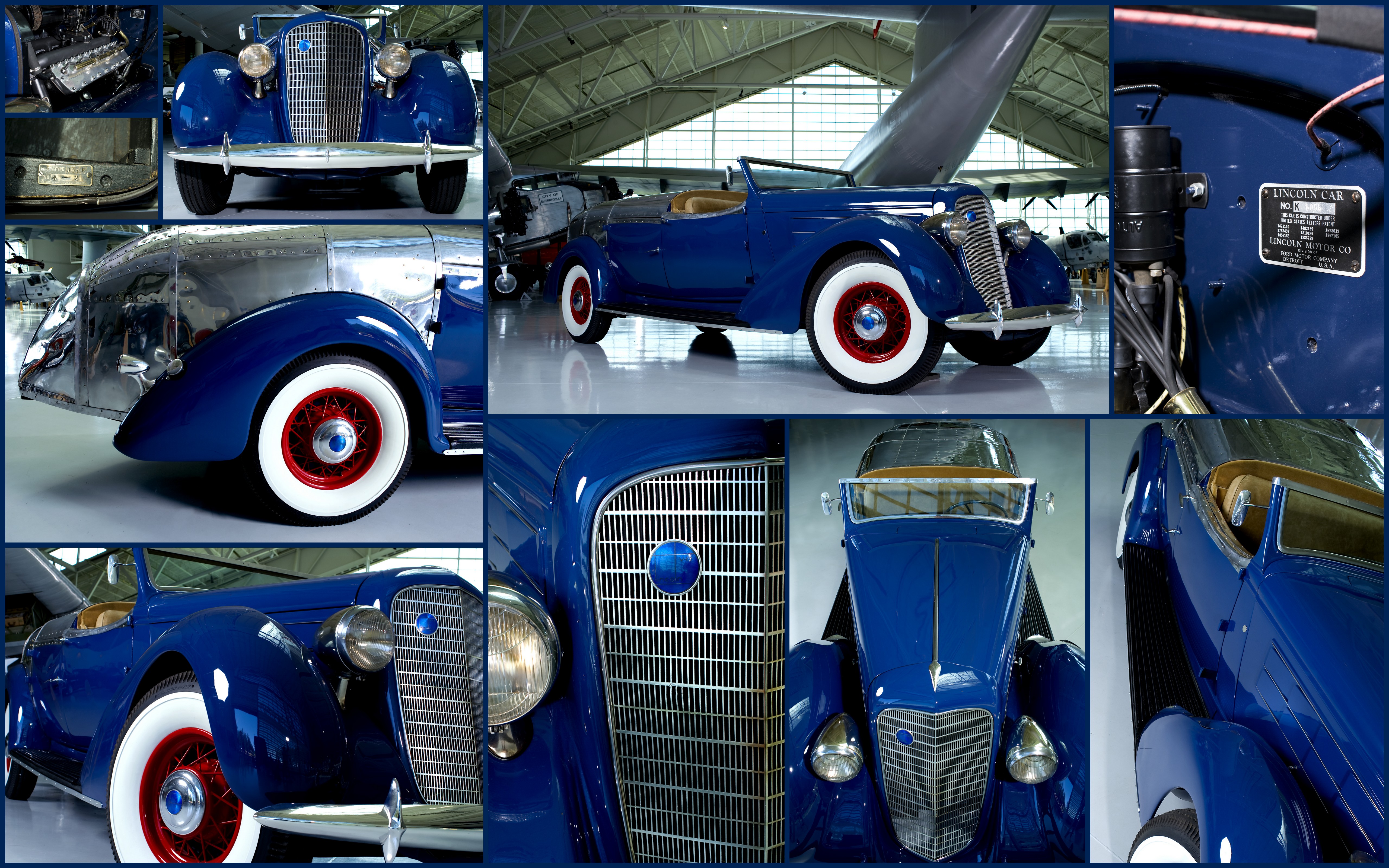
This car is at the Scottsdale Auto Museum! Wow! Nice one!
http://www.scottsdaleinternationalautomuseum.com/howard-hughes-lincoln.html
Industrialist, record-setting aviator, movie mogul, recluse — Howard Hughes was one of the most accomplished and mysterious figures America has ever produced ……
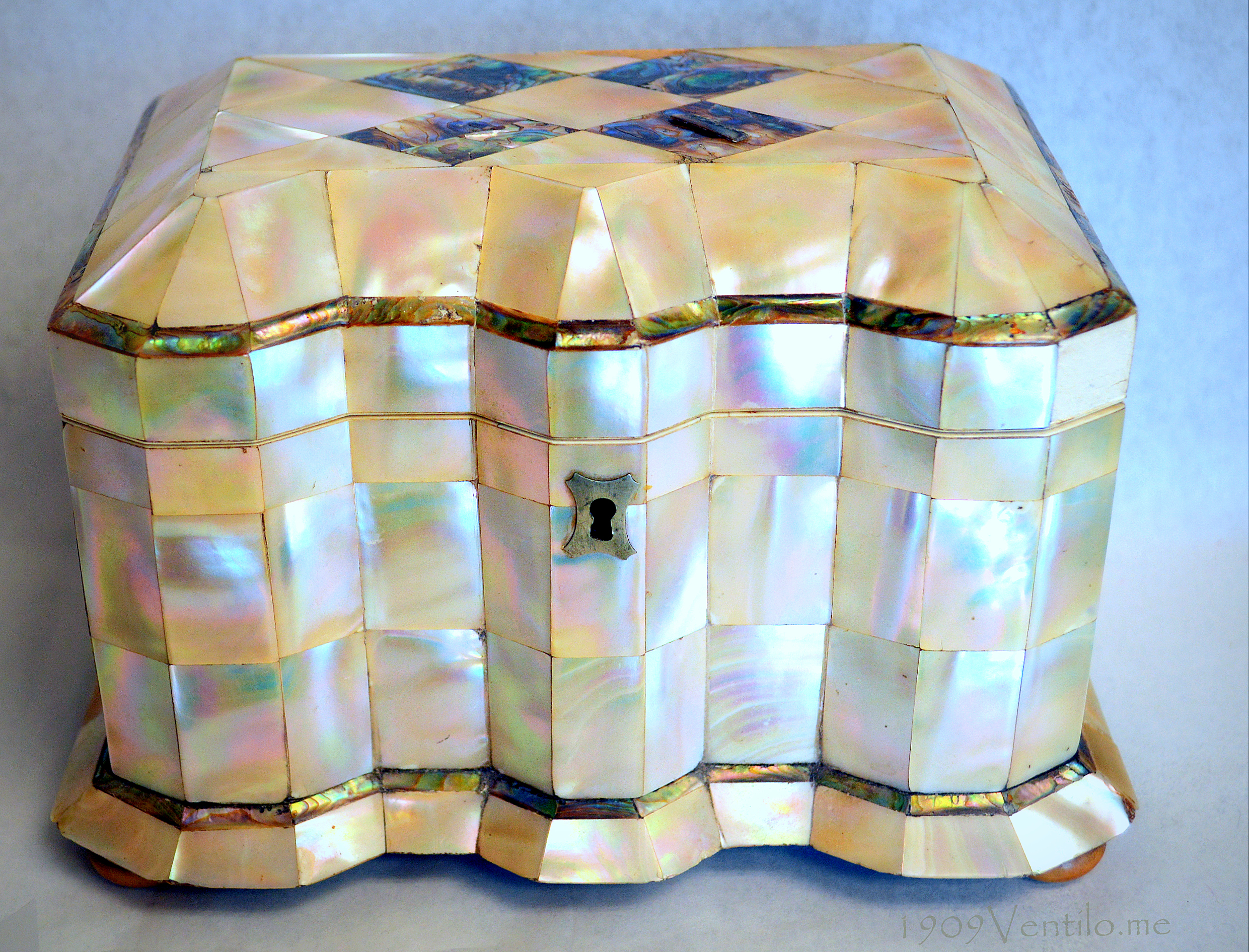
Tea caddy is the name for a small box made to hold tea leaves. In the eighteenth century, tea was very expensive and it was stored under lock and key. The first tea caddies were made with locks. By the nineteenth century, tea was more plentiful and the tea caddy was larger. Often there were two sections, one for green tea, one for black tea. Tea caddies were made of porcelain, silver, or, for the less well-to-do, painted tin.
Note******Info found on the internet…
A wonderful English mother of pearl and abalone tea caddy with interior ivory trim and vegetable ivory bun feet, circa 1830*
Of sarcophagus form, the hinged lid enclosing a pair of lidded compartments, raised on disk feet.
height 5 3/4in (14.5cm); width 6 7/8in (17.5cm); depth 4in (10cm)
Estimate:US$ 2,000 – 3,000
£1,300 – 2,000 €1,500 – 2,300
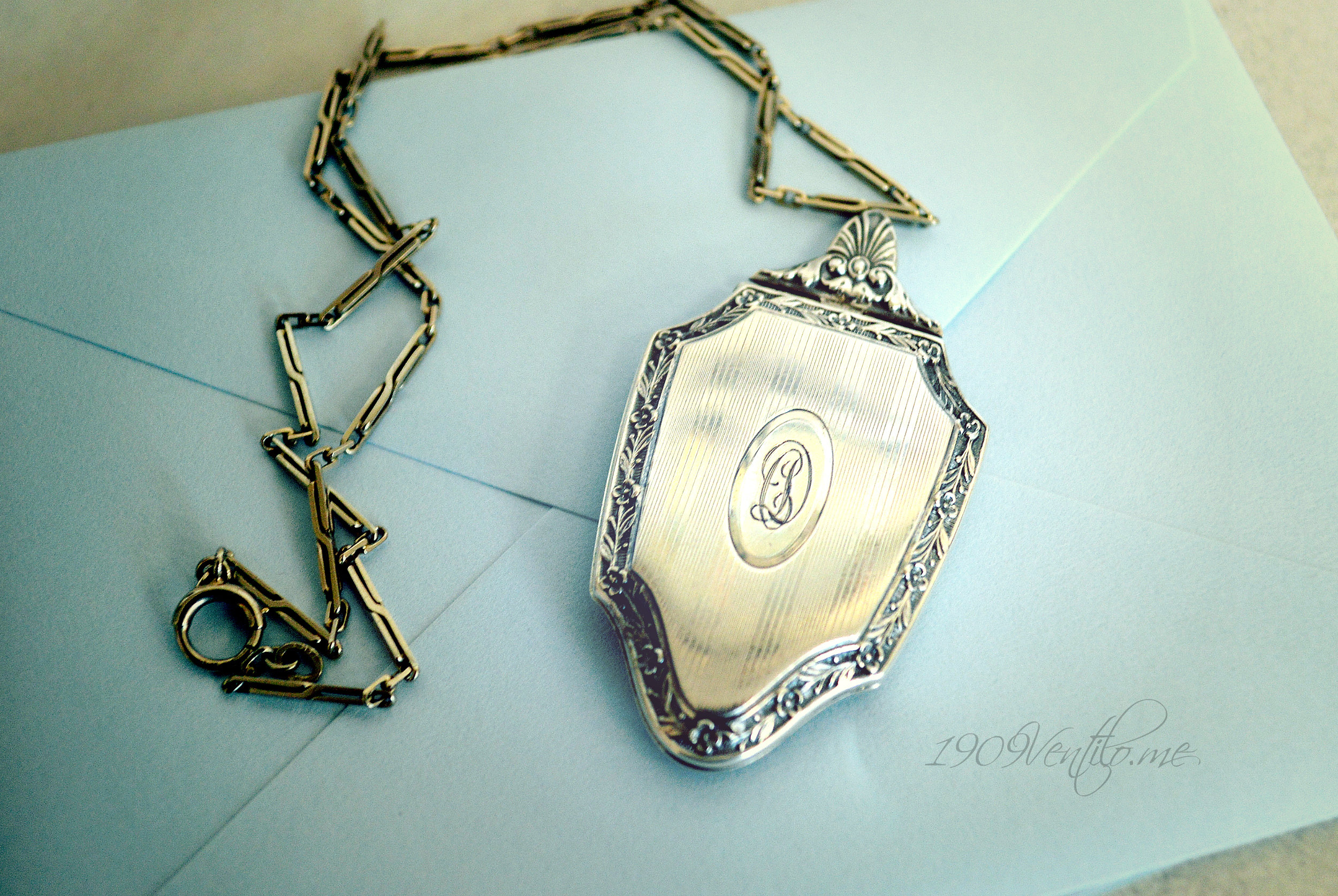
A chatelaine is a decorative belt hook or clasp worn at the waist with a series of chains suspended from it. Each chain is mounted with a useful household appendage such as scissors, thimble, watch, key, vinaigrette, household seal, etc.[1]
Chatelaines were worn by many housekeepers in the 19th century[2] and in the 16th century Dutch Republic,[citation needed] where they were typically used as watch chains for the most wealthy. Similar jewellery was also worn by Anglo Saxon women, as seen from the burial record, but its function is uncertain. The name chatelaine derives from the French term châtelaine and was originally used disparagingly, as it referred to a device designed to have all the tools necessary for the woman of the household to sort out any problem she may encounter in her day, like a fraying curtain.
Ancient Roman women wore chatelaines with ear scoops, nail cleaners, and tweezers.[3] Women in Roman Britain wore ‘chatelaine brooches’ from which toilet sets were suspended.[4]

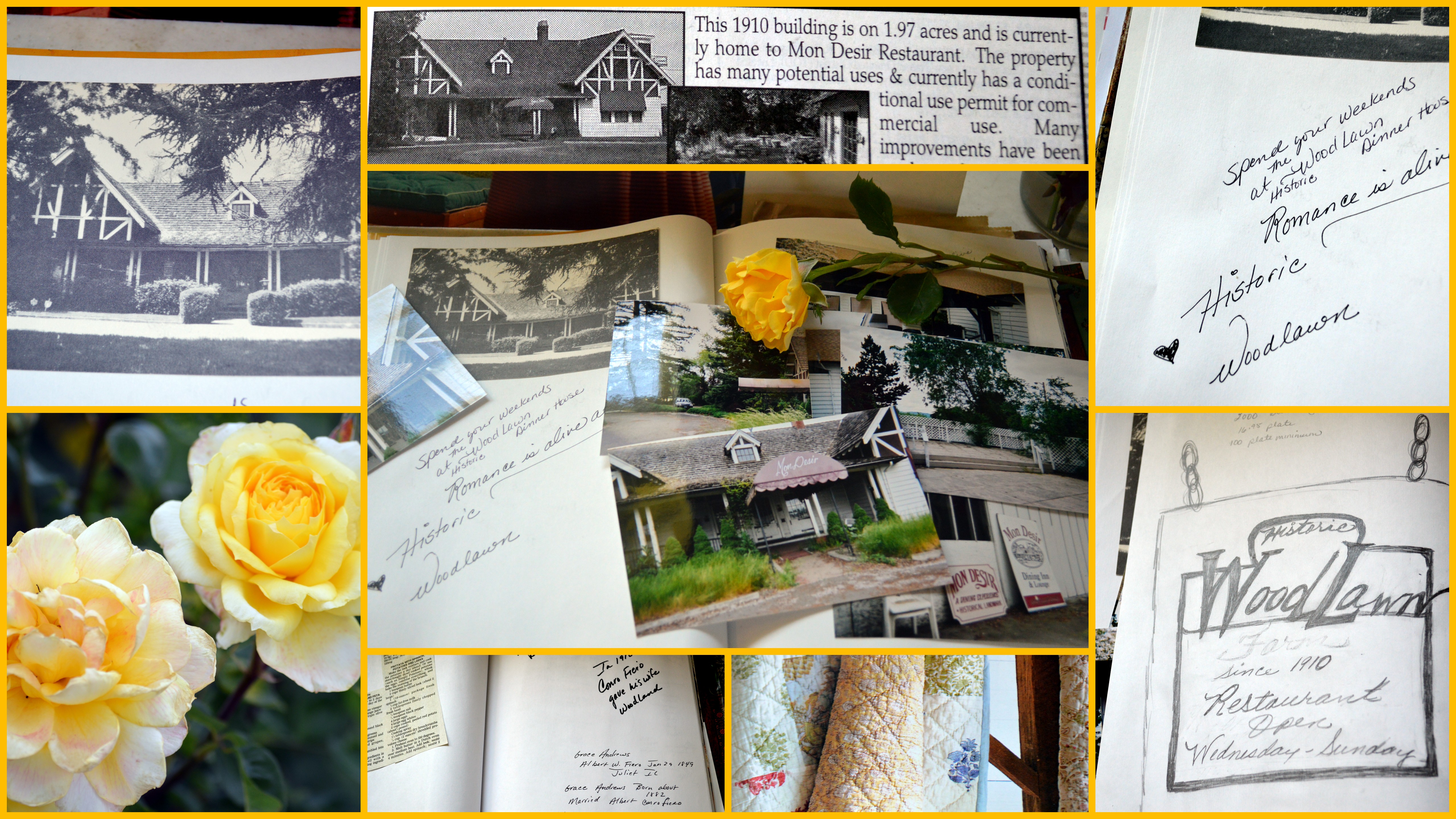
The Conro Fiero House, better known today as Mon Desir Dining Inn, was built in 1910 for the scion of a wealthy Chicago family, one of the Rogue River Valley’s successful “pearboom” orchardists. In 1910 Fiero married Grace Andrews, New York actress who worked with producer-director David Belasco. The house, situated on the 140-acre Woodlawn Orchard, was used by the bride when she was not on the stage. In 1914, during one of her sojourns in Southern Oregon, the actress starred in a film entitled “Grace’s Visit to the Rogue RiverValley,” which was used at the 1915 Panama-Pacific Exposition in San Francisco to promote Jackson County. The design of the house, a bungalow heavily influenced by the English Art sand Crafts Style, is attributed to the noted Portland firm of Whitehouse and Fouilhoux. In the intervening years the house was enlarged slightly at the south end, but its well tower on the north end has remained intact, and the house is well preserved throughout. In 1943,the estate was subdivided and the house began separate use as a restaurant under four successive ownerships. However, orchards still provide the backdrop and setting for the property. The house is significant as one of the outstanding orchard mansions in the county.It possesses integrity of location, design, setting, materials, workmanship, feeling and association with notable historical figures in the local pear industry.A. Conro Fiero, son of A. W. Fiero, a wealthy Chicago businessman, came to the Rogue Valley at the turn of the century to become a millionaire. In 1910 Fiero built the headquarters for his landed estate of 140-acres for his bride, Grace Andrews. Their home became the center of the most lavish entertaining with an Eastern flair, new and thrilling to the SouthernOregon community. The guest list of the “Woodlawn Acres” frequently included some of the more famous names of that era, including that of U.S. Ambassador to Spain, Stan Griffis. Fiero was active in the Medford business community, social affairs, and the development of the Rogue Valley fruit industry. By 1917 the Fieros had lost everything of their fruit crops due to freezing temperatures. Grace Andrews was famous on the New York stage. She rose to stardom under the guidance of David Belasco. Belasco was labeled by the New York Times as “the greatest producer and stage director of his time.” Grace was a member of the Andrews Opera Company family of Minnesota. She made her broadway debut in “Beverly of Grastark” in 1908 on David Belasco’s stage. When the opera company was dissolved, the family moved to Rogue Valley, around 1903.The family pursued agricultural interests, but their greatest was in the cultural development of the valley, music and theater.Miss Andrews met Conro Fiero in 1909 on one of her visits from New York. After their marriage in 1910, she continued with her career, residing in the valley during the off season. It was during one of these visits in 1914 that she starred in a local film “Grace’s Visit to the Rogue River Valley.” This motion picture was used as a Jackson County promotional film att he 1915 San Francisco Panama-Pacific International Exposition. A copy of the film is now in the collections of the Southern Oregon Historical Society in Jacksonville, Oregon.The 140 acres remained one property under three different owners until George T. and Lillian E. Ehrheart bought the property in 1943. They bought the six acres with the Fiero House and made the house into a Southern Chicken Dinner Restaurant. Following the Ehrhearts’ failure after six months, J. M. Alexander and Julia Jemma Tummers bought the place. Julia made the place into a dining inn and named it “Mon Desir.” Julia Tummers 1 American and European cuisine, made Mon Desir one of the noted dining places between Portland and San Francisco.
*Note My scrapbook of the Mon Desir. At one time we put offers in to buy the Mon Desir, this is my scrapbook from that time. I wanted to rename the Mon Desir to Woodlawn because that is what Mr. Fiero called it.
The property has since burned down and everytime I drive by it makes me want to cry!

*Note The Wedding of Grace and Conro Fiero 
Thursday April 5, 2007
By Alice Mullaly
A society wedding is always big news. And for Medford, Oregon in June 1910, the wedding of Grace Andrews and Conro Fiero [Fee-AIR-oh] was on the newspaper’s front page. Under the headline, “The First of Medford’s June Brides,” was a picture of the petite and attractive brunette and a story of her intimate wedding. Held at the Andrews home, the ceremony was performed at noon in a bower of white and pink roses. Grace wore an elaborate gown of white chiffon over white satin. Her tulle veil fell to the hemline and she carried a shower bouquet of white roses. Her two attendants wore white lingerie gowns over pink silk and carried white and pink roses.After the ceremony, breakfast was served in the Andrew’s dining room. Then the couple drove off to Ashland to catch the train that would take them on a honeymoon trip to San Francisco and Del Monte, California.When they returned, the happy couple promised a big party for all their friends at the new home Conro had built for his bride at Woodlawn, his Central Point Orchard. Many people know the home today as the Mon Desir Restaurant.Today’s episode of As It Was was written by Alice Mullaly, the program producer is Raymond Scully. I’m Shirley Patton. As It Was is a co-production of JPR and the Southern Oregon Historical Society. To share stories or learn more about the series visit asitwas – dot- org
 It was a woman’s bedroom, actually a boudoir, and no man belonged in it except by invitation.
Kathleen Winsor
*I love to photograph! xoxo
BENEVOLENT AND PROTECTIVE ORDER OF THE ELK (BPOE)
Early BPOElks History- “Elks are never forgotten ~ never forsaken.”
For many years, this preamble served as a guiding principle for actions and activities for its members. Elks were required in the original constitution to attend the funeral of a fallen brother. Their first benefit raised $1,000 for a widow of a deceased Elk – an astounding amount of money at the time. As other Elks died, a special ceremony was created called the Lodge of Sorrow with the first public service being held on March 20, 1870. This became an annual event that we now celebrate as our Memorial Service. Sometime after that a provision was made for the chair Officers to become the Standing Relief committee. Any Elk in distress would petition this committee for help which apparently was often requested and granted. For example, Salisbury lodge archives contain a number of telegrams from members who were stranded far from home and in need of financial assistance to help them with their predicament. For the first 21 years, the Elks grew gradually from one Lodge of 58 members to 158 Lodges with 13,067 members. Once theatrical membership restrictions were removed growth really took off and by 1909, there were 1,155 Lodges with 304,899 members. By the end of WWI, nearly 200,000 more were added to the rolls with the number of Lodges increasing to 1,280. In North Carolina, 20 lodges were chartered during this golden period. All except Washington #822 are still operating.
*Note Early on, members of the Elks began wearing an elk’s tooth as identification.

 Elks BPOE
This incredible vintage fob dates circa 1900’s to 1910’s. The piece features two real or Faux Elk’s teeth, which are encased in an ornate 14k yellow gold cap. 14k Monogramed. Name: Potter, Frederick E. — (I believe). A Democrat. Candidate for Governor of New Hampshire, 1900. Burial location unknown.
http://www.onlineauction.com/auction/1649968/Vintage_14k_gold_unusual_pendant%21%21%21source http://www.elkshistory.org/
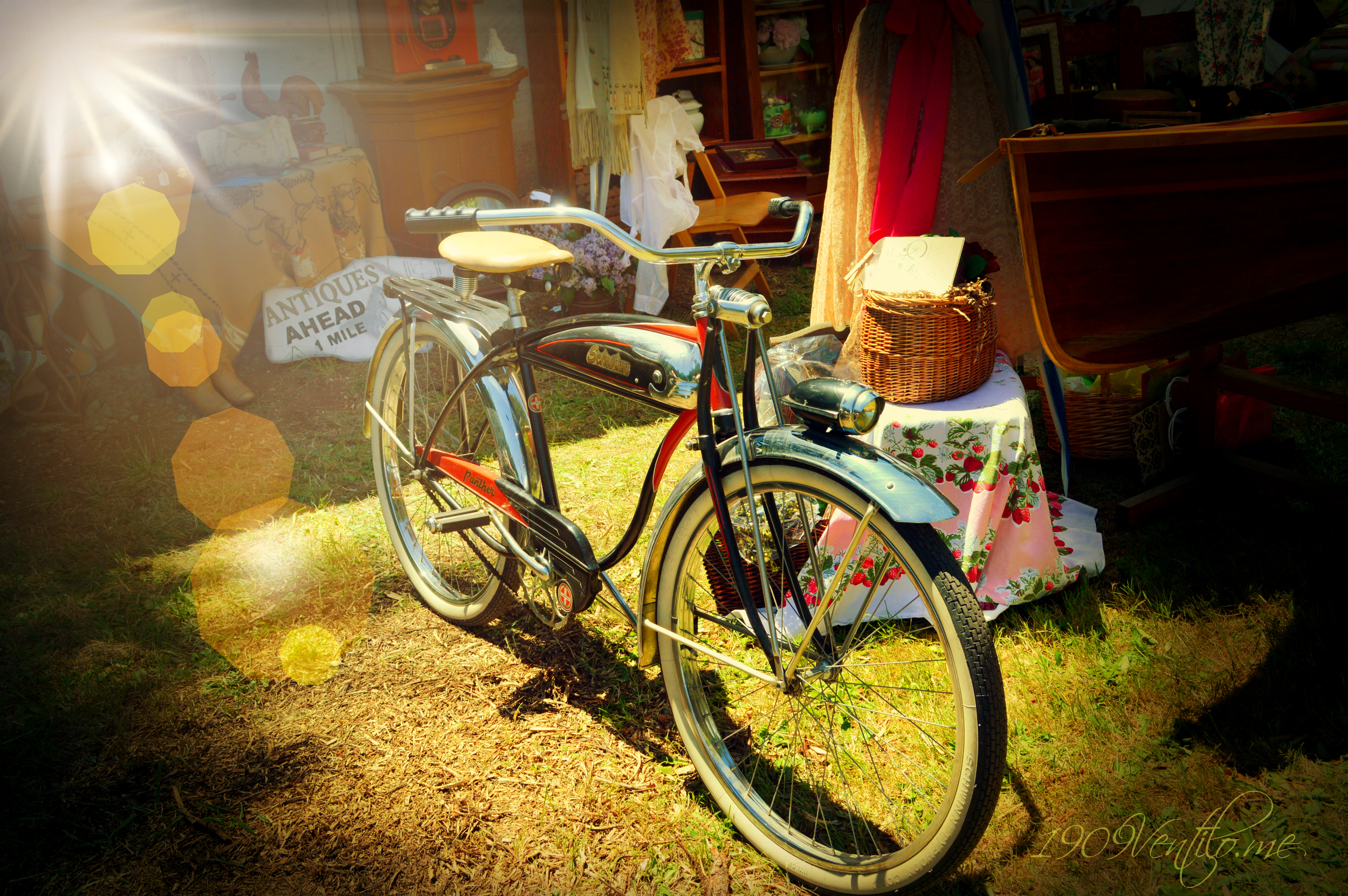 I am sure many kids read this ad over and over dreaming they could have this cool bike! It has been collecting dust in our garage, time to share it with the next owner. 🙂
Famous Schwinn spring fork, Rocket Ray headlight, super spring loaded Schwinn Frame and new tan Koro seat top saddle with chrome springs. Five times stronger Schwinn chrome tubular rims, sparkling Chrome-plated fenders, chrome trimmed tank, sleek chaingurard and sturdy luggage carrier.
http://www.onlineauction.com/auction/1648903

05/04 – 05/05, 2013 – Barn & Field Festival ~ BFF
Marcola, Oregon
Location: 39648 Howard Road
Contact Phone: 541-747-3185
Website: www.indulge1461.com/bff-barn–field-festival.html
* Getting all my stuff ready to head out to the BFF sale! So excited! There is a band too!
On 10 acres, should be lots of antiques and collectibles!! hope to see you there! xoxo

*See You there!!! 🙂

"The powers of the mind are memory and imagination: without memory, we have no past; without imagination, no future."
J Bardens


Learning to live authentically in a world that expects perfection
A gaggle of musings and meanderings
Peterborough and Douro Ontario Portrait Photographer
Old World Charm Meets Modern Comforts. Come and Experience the Beauty and History of the Keweenaw.
155a Northcote Road London SW11 6QB Tel 020 7228 6850
... Making Broken Beautiful
393 bushwick ave Brooklyn NY SELLING ON INSTAGRAM @reuseamericany . Open Wednesdays - Sundays 12-5pm We Buy Furniture Every Day +1 (305) 984-1051
Tips and tricks for all your automotive troubles
The Universe is Made of Stories, not Atoms
sharing vulnerability and wearing clothes
DA2697
Just a couple guys running a small farm in the Cascades.
Express yourself. It is later than you think.
A pretty place for personal style, cooking, DIY, and home inspiration.
Designing delightful reading experiences, both innovative and traditional.
Sharing my creative journey...
"People buy tickets to theatres, not movies." -- Marcus Loew
the intersection of graphic design + picture books
Having fun Hunting for vintage treasures!
Creating a beautiful life, one stitch at a time
Unique Destinations, Weird History and More…
I'm K Murphy. I design.
Where Vintage Designer Fashion Meets the Runway
Reflections of a Female Seminary Graduate
Updates, Fashion Finds, News about Nelda's and things we love.
Fine vintage clothing and accessories from 1920s - 1980s
I love my vintage everything!
All your friends are here!
Blogging about Costume Jewelry, Gemstones, Clothing, Shoes, and Accessories
Inspired vintage for you and your home.

 1909ventilo's Blog