Posted at 7:20 pm by 1909ventilo, on December 3, 2010
Christie’s
25 June 2004
New York, Rockefeller Plaza
Lot Description
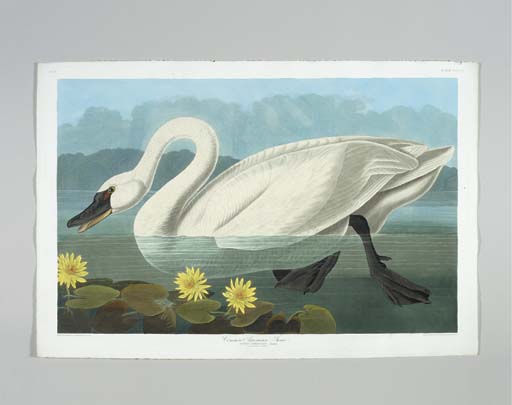
Common American Swan (Plate CCCCXI)
Tundra Swan, Cygnus columbianus
Hand-colored engraving with aquatint and etching, on J Whatman dated 1838, a few tiny tears at margin extremes, otherwise extremely fine.
My great gramma, and my gramma both collected swans, I bet they both felt a lot of their beauty had to do with the fact that they mate for life!
Posted at 10:21 pm by 1909ventilo, on December 2, 2010
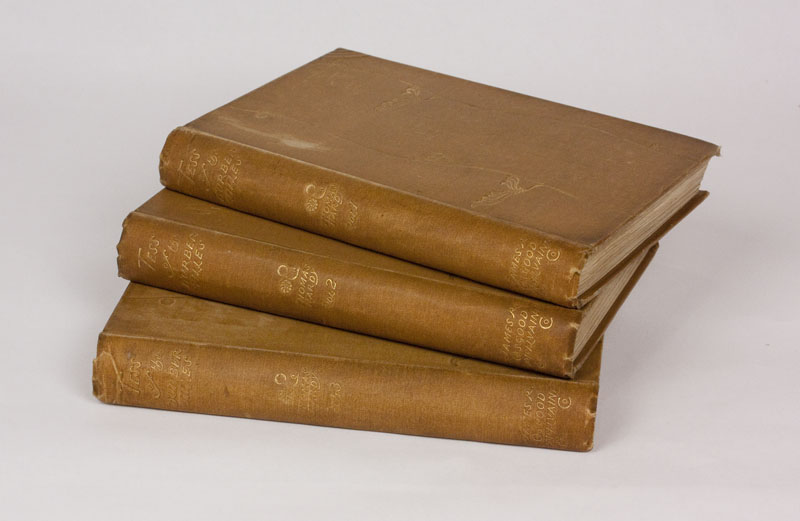
I Have Collected Many Thomas Hardy Books None Of High Value As These Pictured Below. Have You Read The Tragic Story? You May Want To Curl-up On The Couch And Watch The Movie It’s Great! Make Sure You Have A Steaming Cup Of Chocolat’ And Warm Wool Blanket! If Your A Woman It Just May Be The Reminder You Need Of What A Great Time period We Live In Today!
($9,914) 7 June 2010London, South Kensington
HARDY, Thomas. Tess of the D’Urbervilles. A Pure Woman. London: Macmillan, 1926. Large 8° (282 x 195mm). 41 wood-engraved plates and illustrations by Vivienne Gribble, folding map. Original quarter vellum (bottom corners bumped), slipcase. Provenance: Thomas Hardy (gift inscription to:) — Florence Emily Hardy (Max Gate book label amended in manuscript).
ONE OF 325 COPIES SIGNED BY HARDY, PRESENTATION COPY TO THE AUTHOR’S WIFE, inscribed: ‘To: Florence Emily Hardy, from Thomas Hardy. 22 October 1926’. Hardy and Florence Dugdale (1879-1937) had met towards the end of 1905, as author and admirer, and in 1906 she began assisting him with research to complete The Dynasts. She took over the running of Max Gate after Emma Hardy died in November 1912, and the two married on 10 February 1914. A FINE ASSOCIATION. Cf. Purdy, pp.77.
HARDY, Thomas. Tess of the D’Urbervilles. A Pure Woman. Faithfully Presented by Thomas Hardy. In three volumes. London: James R. Osgood, McIlvaine and Co. , 1891.
First edition, mixed issues but all dated 1891. Three octavo volumes. (5 x 7 1/2 inches). [8], 263, [1]; [8], 277, [1], [2, blank]; [8], 277, [1, printer’s imprint], [2, blank] pp.
Posted at 1:05 am by 1909ventilo, on December 1, 2010
I am bidding on a vintage new old stock bottle of Cabochard! Can’t wait to see if I get it!
Cabochard is a fragrant image of Alix Gres. Even the name, chosen by Madame Gres herself (in French Cabochard means ‘stubborn’ or ‘headstrong’) reflects her free spirit and will. Cabochard was created after Madame Gres‘ trip to India. She described a beautiful perfume to the young perfume creator Guy Robert – very flowery, rich like tuberose yet softer, contrasted by fresh, slightly green note. It was a water hyacinth! After several trials, Madame Gres recognized her perfume. It was light and floral. However, the trend dictated intensive and strong chypre (Tabac Blond (1919), Cuir de Russie (1924), Scandal (1933), Bandit (1944)), so Madame Gres decided to launch two perfumes at the same time: floral Chouda and leather chypre Cabochard, created by Bernard Chant with IFF.
Cabochard was launched in 1959 and instantly became very popular; Madame Gres said that it reminded her of her walks along the long and empty beaches of India: sharp freshness of the morning air, warmth of sandalwood, a touch of flower and comfort of the sea breeze.
A couple of months after it was created the production of Chouda was suspended. The delivered 5 liters of the perfume was most probably worn by Madame Gres herself.
The first bottle of Cabochard was very plane and simple (Madame Gres wanted to minimize the costs), with pharmaceutical top and a grey bow. The Chouda bottle had a green bow.
By information of Parfums Gres
MADAME GRÈS, A RARE DAY DRESS, 1940S
black moiré silk, with elbow length sleeves and full skirts, the bodice draped and folded to create a waistcoat-effect, labelled Grès, secondary label Santina Buenos Ayres
£6,250
($12,406)
Price includes buyer’s premium
I have never seen such a photo on Christie’s before Yikes! they must of been in some kind of hurry…..
Posted at 9:03 pm by 1909ventilo, on November 24, 2010
Tucked away in an old house in rural West Virginia, the painting was an enigma coated with a century’s dust. Depicting a seemingly obscure battle scene, its presence amid the attic’s cobwebs stirred little interest among those living below.
But Jon Buell, who discovered the painting while rummaging through his grandparents’ Weston, W. Va., attic last Thanksgiving, was fired with excitement.
He grilled relatives and searched the Internet, soon confirming that the 5-by-7-foot painting was the work of his great-great-grandfather, Texas artist Henry Arthur McArdle. It is a smaller version of McArdle’s famed 8-by-14-foot painting, The Battle of San Jacinto, which hangs in the Texas Senate chamber.
Art experts for decades thought the smaller canvas had perished in a 1918 house fire.
“I thought it might be worth $10,000 or $20,000,” said Buell, the suburban Washington, D.C., district manager for a hamburger chain. “My grandmother told me to do what I wanted, to see if I could sell it. I thought happy days were here.”
Atlee Phillips of Dallas’ Heritage Auctions said the painting is expected to bring about $100,000 when it is offered to bidders on Nov. 20.
Many believed the painting was destroyed when DeShields’ house burned in 1918. Buell, though, believes McArdle gave the painting to his son, Ruskin McArdle, who took the work with him when he became librarian of the U.S. Senate. Upon retirement, the younger McArdle joined other family members in West Virginia.
Henry McArdle was born in Belfast, Ireland, in 1836. At age 14, he immigrated to Baltimore, where he studied art. During the Civil War, McArdle made maps for the Confederate Navy and served on the staff of Gen. Robert E. Lee.
Heritage Auctions said the 5-foot-by-7-foot painting of the Texas Revolution’s decisive Battle of San Jacinto was expected to go for $100,000 to $150,000. It sold on Saturday at auction in Dallas for $334,600.
Posted at 11:34 pm by 1909ventilo, on November 23, 2010
The place I would go would be Paris!
The fine landscape, Eiffel Tower staring down at me.
 The warm blissfulness of my steaming hot chocolat as I walk in to my hotel room...
 aaaahhh.....  The food excites me the best!
Bread, pasta, salad and chocolate pleasures.
Then after lunch a gorgeous stroll down the path for clothes.
The big windows previewing casual to evening gowns....
 someday.... someday!
Posted at 10:47 pm by 1909ventilo, on November 22, 2010
A BLACK COCKTAIL DRESS BY DIOR full skirted sleeveless dress decorated with three applied bows, with separate boned underdress, labelled CHRISTIAN DIOR MADE IN ENGLAND BY CHRISTIAN DIOR LTD LONDON ‘13123’, another handwritten label underneath reading DIORAMA, and smaller tags reading Sample Size 12 Price realized Christies $2087
Posted at 3:24 am by 1909ventilo, on November 18, 2010
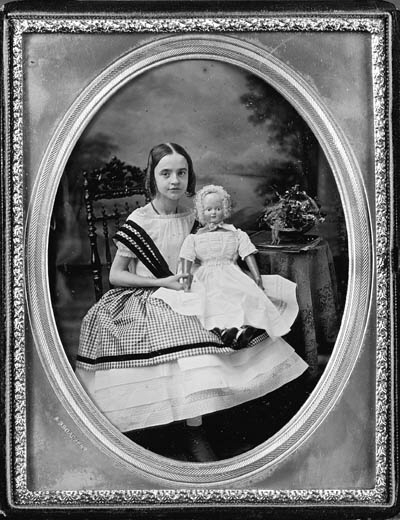
SAMUEL BROADBENT (1810-1881)
Portrait of a young girl with her doll
Fully silvered half-plate daguerreotype. 1850s. Embossed credit S. BROADBENT on the brass mat; unsealed. Contained in a leather case with convex glass.
Posted at 10:02 pm by 1909ventilo, on November 16, 2010
I saw this menu for sale on OnlineAuction.com I was curious if the restaurant was still in business, I had never heard of it. It has shut down, however Baby Doe’s story was so interesting to me, of course I had to put it on my blog!
“Went down to Leadville from Matchless – the snow so terrible, I had to go down on my hands and knees and creep from my cabin door to 7th Street. Mr. Zaitz driver drove me to our get off place and he helped pull me to the cabin. I kept falling deep down through the snow every minute. God bless him.” ···· “Baby Doe” Tabor, March, 1935
On March 7, 1935, Baby Doe Tabor was found dead of a heart attack in her small shack at the famous Matchless Mine, just outside Leadville, Colorado. She had, for whatever reason, adopted the storage shack at the Matchless Mine as her living quarters since her husband’s death in 1899, 35 years earlier. Contrary to popular belief, she did not “hold on to the Matchless as it will pay millions again,” as some have incorrectly reported were Horace Tabor’s deathbed words. The Matchless Mine had long since been lost to foreclosure and had failed to produce even with several new attempts on the part of the new owners. Baby Doe was living in the tiny cabin only due to the generosity of the current owners of the worthless mine.
Elizabeth Bonduel McCourt “Baby Doe” Tabor, once a millionaire, had died in virtual poverty. After her death, 17 iron trunks that had been placed in storage in Denver were opened, as well as several gunny sacks and 4 trunks that had been left at the St. Vincent’s Hospital in Leadville. All that was left from the Tabor fortune were several bolts of unique, untouched and quite exquisite cloth, several pieces of china, a tea service and some jewelry, including a diamond and sapphire ring. The famous watch fob and chain given to her husband, Horace Tabor, at the opening of the $700,000 Tabor Opera House in Denver was also found, along with several memorabilia pieces.
This incredible story has captured the imagination of the world for decades.
Given the scandal of the divorce and the differences in their ages, the wives of Denver’s richest men refused to accept her as one of their own. However, despite the age difference and the social shuns, nothing could wilt their blossoming marriage and they shared a loving home life for the next ten years.
On the lawn outside the mansion, a hundred peacocks strutted and the landscape was adorned with more controversial decorations, which included some nude statues that further offended Baby’s highly proper female neighbors. In response, the highly spirited Baby Doe had her dressmaker come in and make dresses for the statues. The two lived extravagantly, spending as much $10,000 a week on lavish parties, traveling, and other luxuries.
At their height, the Tabors were one of the five richest families in the country. During this time they built the Tabor Grand Opera House in Denver, had two daughters, nicknaming them Lillie and Silver, and a stillborn son.
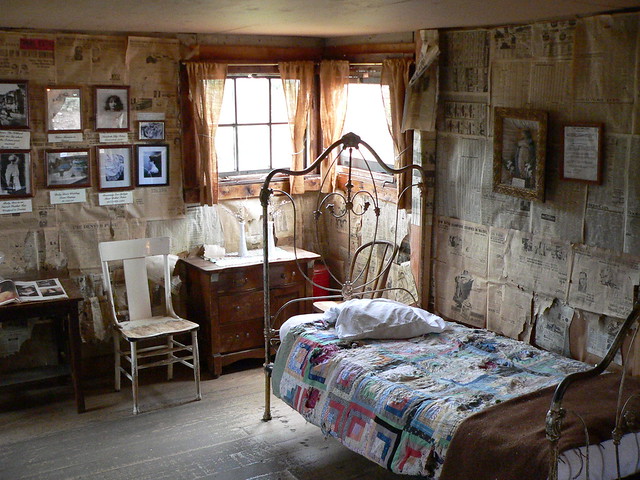
Baby Doe Tabor’s cabin at Matchless Mine
.
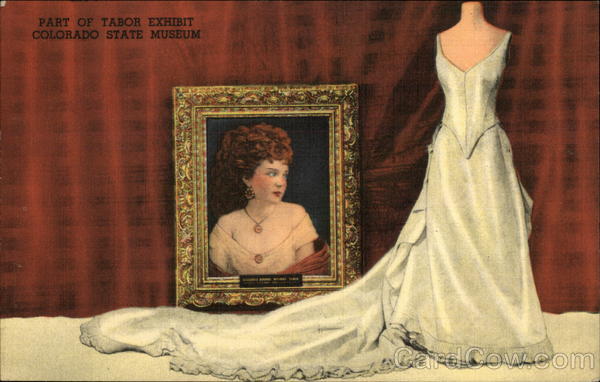
“Baby Doe” Tabor and her wedding dress. Drama of the silver mining era in Colorado is personified in H.A.W. Tabor and “Baby Doe.” They were married in Washington while he was “Silver Midas of the Rockies.” Tragic reversals transformed their station from wealth to poverty. E. 14th and Sherman Street. Baby’s wedding dress cost $7,000 and Horace gave her a $75,000 diamond necklace as a wedding gift. Horace’s congressional friends, including the President, attended the wedding, but their wives refused to attend the “disgraceful” event. The scandal of the alleged divorce and marriage raged on, and was front page news across the country. It was an embarrassment to Washington, as well as other prominent figures in high social circles.
The 12-inch pressed bisque bébé by French doll maker Thuillier was originally owned by Lily Tabor of the legendary and scandalous 19th century Denver family. It sold for $70,000.
Posted at 9:04 pm by 1909ventilo, on November 14, 2010
Louisa May Alcott
“Christmas won’t be Christmas without any presents,” grumbled Jo, lying on the rug.
“It’s so dreadful to be poor!” sighed Meg, looking down at her old dress.
“I don’t think it’s fair for some girls to have plenty of pretty things, and other girls nothing at all,” added little Amy, with an injured sniff.
“We’ve got Father and Mother, and each other,” said Beth contentedly from her corner.
The four young faces on which the firelight shone brightened at the cheerful words, but darkened again as Jo said sadly, “We haven’t got Father, and shall not have him for a long time.” She didn’t say “perhaps never,” but each silently added it, thinking of Father far away, where the fighting was.
Nobody spoke for a minute; then Meg said in an altered tone, “You know the reason Mother proposed not having any presents this Christmas was because it is going to be a hard winter for everyone; and she thinks we ought not to spend money for pleasure, when our men are suffering so in the army. We can’t do much,but we can make our little sacrifices, and ought to do it gladly. But I am afraid I don’t” And Meg shook her head,as she thought regretfully of all the pretty things she wanted.
“But I don’t think the little we should spend would do any good. We’ve each got a dollar, and the army wouldn’t be much helped by our giving that. I agree not to expect anything from Mother or you, but I do want to buy UNDINE AND SINTRAM for myself. I’ve wanted it so long,” said Jo, who was a bookworm.
“I planned to spend mine in new music,” said Beth, with a little sigh, which no one heard but the hearth brush and kettle holder.
“I shall get a nice box of Faber’s drawing pencils. I really need them,” said Amy decidedly.
“Mother didn’t say anything about our money, and she won’t wish us to give up everything. Let’s each buy what we want, and have a little fun. I’m sure we work hard enough to earn it,” cried Jo, examining the heels of her shoes in a gentlemanly manner.
Little Women. This scene is set during the American Civil War
Posted at 8:21 pm by 1909ventilo, on November 14, 2010
Now I lay me down to sleep,
A bag of peanuts at my feet;
If I should die before I wake,
Give them to my sister Kate.
This is a famous children’s prayer which became widely used in the 18th century when of course childhood mortality was very high. It became popular on both sides of the Atlantic.
Posted at 8:04 pm by 1909ventilo, on November 14, 2010
So you probably heard of the story below, you mulled it over in your head as you gathered the facts. But I wanted to know who was the girl in the painting? I could not find out any information about “Portrait of a Girl” but I did find information about Jean-Baptiste-Camille Corot, I especially love his quote!
In later life, he remained a humble and modest man, apolitical and happy with his luck in life, and held close the belief that, “men should not puff themselves up with pride, whether they are emperors adding this or that province to their empires or painter who gain a reputation.”
Jean-Baptise-Camille Corot, Portrait of a Girl, 1857-8, which went missing on June 29, 2010 and was recovered weeks later. Image courtesy of the New York Times.
What began as a summer comedy of errors – an Upper East Side doorman finds a Corot painting missing on a courier’s drunken bender – took a strange turn earlier this month when the painting’s owner realized its co-owner may have been involved in its disappearance. The following is a summary of the news and events that have unfolded over the past few weeks in the case.
The story begins like this: on July 29th a doorman at 995 Fifth Avenue, near 81st Street, discovered a painting in the bushes in front of the building. The nineteenth-century painting, “Portrait of a Girl” by Jean-Baptiste-Camille Corot, whose estimated value is $1.4 million, was apparently lost hours earlier by an intoxicated courier, James Carl Haggerty. Thinking the artwork belonged to one of the building’s residents, doorman Franklin Puentes stored it inside his locker after unsuccessful attempts to locate its owner. Puentes then went on a three-week vacation. When he returned, he heard the buzz about the missing painting and promptly turned it over to the police.
Jean-Baptiste-Camille Corot
Jean-Baptiste-Camille Corot (French, 1796-1875)
Jean-Baptiste-Camille Corot was born in Paris, the son of shopkeepers. For five years he served an apprenticeship in the drapery business before turning to art. From 1822-25 he studied first under Michallon and then landscape painter Victor Bertin. Corot believed an artist must develop his passions for nature and painted mainly out-of-doors.
Posted at 8:25 pm by 1909ventilo, on November 12, 2010
An Enamel On Copper European-Subject Snuff Bottle, Qianlong Mark And Period, Sold for $662,500 (est. $250/350,000). Photo: Sotheby’s.
The highlight of the collection was An Enamel On Copper Snuff Bottle, Imperial, Palace Workshops, Beijing, Qianlong Mark And Period (1736-1795) which doubled the low estimate to sell for $662,500 (est. $250/350,000). The superb bottle would possibly have been owned by the Qianlong emperor who was known for his fascination with European Culture.’’
Snuff bottles were used by the Chinese during the Quing Dynasty to contain powdered tobacco. Smoking tobacco was illegal during the Dynasty, but the use of snuff was allowed because the Chinese considered snuff to be a remedy for common illnesses such as colds, headaches and stomach disorders. Therefore, snuff was carried in a small bottle like other medicines. The snuff bottle is comparable to the snuff box used by Europeans.
Posted at 6:39 pm by 1909ventilo, on November 9, 2010
‘It’s raining, it’s pouring The old man is snoring
He went to bed and he bumped his head
And couldn’t get up in the morning’
The rhyme is believed to have originated from Ireland during the commonwealth period (1649-1660) and the dictatorial conditions in the country at that time.
The poor weather conditions in line one reflect the genocide committed against Irish Catholics whilst the last three lines are most likely a wish that Oliver Cromwell, the Lord Protector of England, will die in his sleep.
 Christie’s
















 1909ventilo's Blog
